
Standing seam technology: How metal roofs are joined for lasting durability
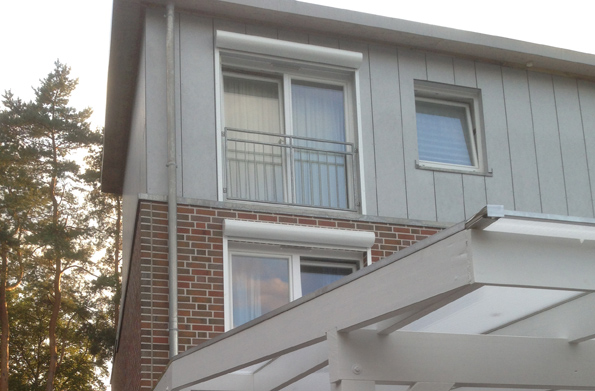
When looking at a metal roof or a metal-clad façade, you often see long, narrow metal sheets with slightly raised lines between them. These lines are characteristic of standing seam technology.
Standing seam technology is a proven trade technique used to join individual metal sheets—known as pans —together. It is used primarily on roofs and façade cladding What makes it special is that the sheets are joined without screws or other fasteners having to be driven visibly through the metal surface.
What does “standing seam” mean?
The individual metal sheets have raised edges along their long sides. When two sheets are laid side by side, these edges meet directly.
They are then folded into one another, or seamed. This creates a narrow, upright joint—the so-called standing seam.
The result is a strong, largely rainproof joint between the individual metal sheets.
Put simply:
Metal sheet + metal sheet + folded joint = standing seam.
How is a standing seam roof fastened?
The metal sheets are not simply laid loosely on the roof. They are fastened to the substrate using so-called clips These fasteners are located beneath the metal sheets or within the seam joints, so they are not visible afterward.
This has a key advantage: the surface of the metal roof does not need to be repeatedly drilled through with screws for fastening.
At the same time, metal expands in warm weather and contracts again in cold weather. In properly constructed standing seam roofs, this natural movement of the material is taken into account in the design.
Which metals are suitable for standing seam technology?
A variety of metals can be used for standing seam roofs and façades, for example:
- titanium zinc
- aluminum
- copper
- stainless steel
- coated metal sheets
The right material depends, among other things, on the building’s design, environmental conditions, the desired appearance, and, of course, the budget.
Copper, for example, changes color significantly over the years and develops a distinctive patina. Zinc and aluminum, in turn, offer a wide variety of modern finishes and colors.
Why has standing seam technology been used for so long?
One important reason is its combination of function and design.
When properly designed and installed, standing seam systems offer several advantages:
- long service life
- high weather resistance
- rainproof joints between the metal sheets
- no fasteners visible through the surface
- suitable for roofs and façades
- clean, modern lines
- can also be used on roofs with unusual shapes
- metal can generally be recycled at the end of its service life
The narrow seams also give a building a very distinctive appearance.
Double-lock standing seam and angle standing seam
However, not all standing seams are the same.
In the classic double-lock standing seam the raised edges of the sheets are folded together several times, creating a particularly secure joint. This method is often used on roofs.
Another option is the angle standing seam. Because of its appearance, it is often used on façades or steeper surfaces.
The choice of seam technique depends on the building, the roof pitch, and exposure to wind and weather.
Craftsmanship remains essential
A finished standing seam roof may look simple at first glance, but making one requires expertise and precision.
The metal sheets must be cut to size, bent, fastened, and seamed together correctly. At the same time, details such as roof edges, penetrations, windows, junctions, drainage, and provision for the movement of the metal must be taken into account.
Errors in design or installation can later lead to leaks, deformation, or damage.
That is why standing seam systems should be installed by appropriately qualified specialist contractors.
Traditional technology for modern buildings
Standing seam technology is by no means limited to historic buildings. On the contrary, metal roofs and façades are once again widely used in modern architecture.
The long metal sheets and regular seams create a clean, understated structure. At the same time, they can be used to shape even more complex buildings.
Standing seam technology therefore brings together something particularly interesting in the building trades: a time-tested installation technique and the demands of modern architecture.
So what looks like a simple line on a metal roof is the visible result of precise craftsmanship.
Have questions about this? -> Please feel free to contact us.
Text: AI GENERATED



Hinterlasse einen Kommentar
An der Diskussion beteiligen?Hinterlassen Sie uns Ihren Kommentar!